How to Get the Most of Teletherapy

TIPS FROM KCC STAFF

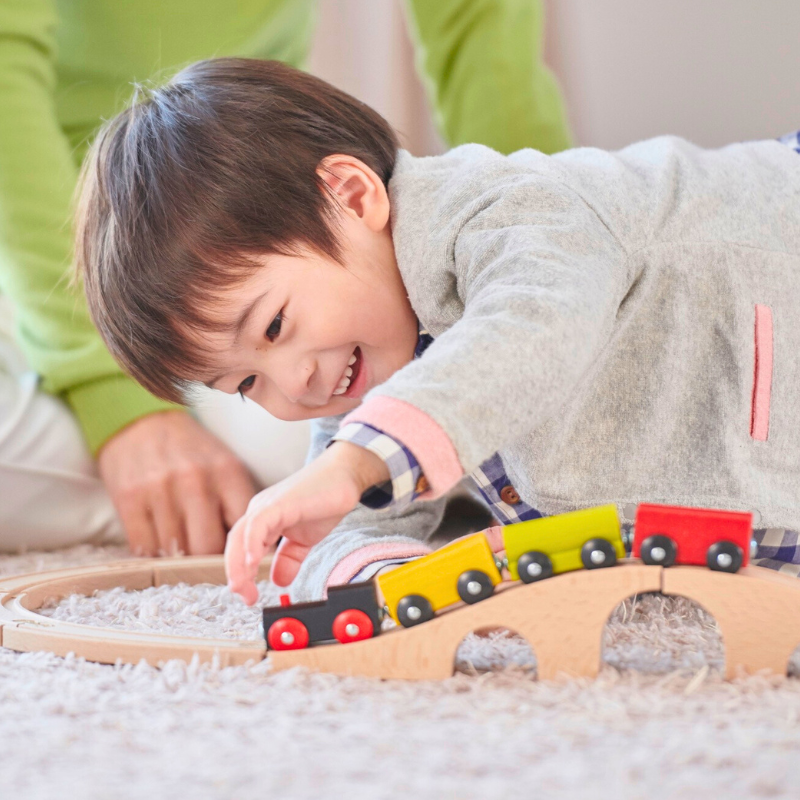
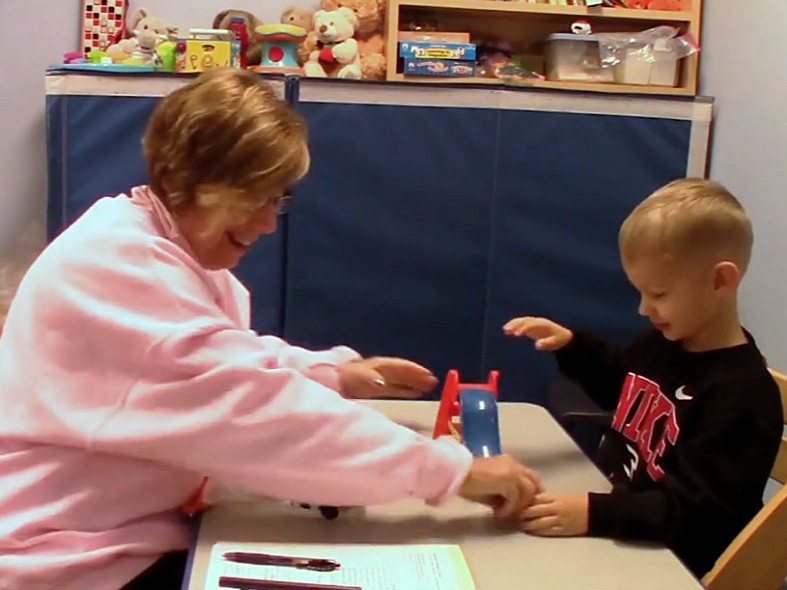
In this “new normal” due to the pandemic, many children are taking part in online telehealth sessions. We have compiled a few tips to help make your child’s speech and occupational therapy sessions run a little smoother.

A good tip to remember at the start: Your child will take their lead from you. Make telehealth seem like a fun new adventure and they are likely to get on board.

Before the session begins:

  • Designate an area for your child’s telehealth session away from the hubbub of the rest of the house.
  • For tabletop tasks, make sure your child is seated and that their chair has arms.
  • If your child is distracted by background noise, have them connect to the computer’s audio via headphones.
  • Remind your child 10 minutes before the appointment so they can shift gears and get ready to learn.
  • Be prepared with supplies. If your child is working on handwriting, you may need paper, writing utensils, and scissors. In speech sessions, you may need to provide reinforcement or motivating items.

During the session:

  • Depending on the child’s age and abilities, you may need to be directly involved in their sessions. Be sure that you or another adult is nearby in case your child needs help.
  • To maximize participation, talk with the therapist ahead of time about how to best use your child’s favorite toys and activities as reinforcement. Then make sure to have them close at hand for when they’re needed.
  • Let your child answer without help and work as independently as possible. The therapist will let you know when it’s time to get involved.
  • This is a great opportunity for therapists to give you real-time suggestions while your child is in their home setting. For occupational therapy, work on tasks like brushing teeth and dressing. For speech and language, practice making requests for the child’s favorite items.

After the session:

  • Ask questions! It helps to know why your child is doing an activity. This will also help you come up with ideas of activities to do at home that will reinforce what your child is learning in therapy.
  • Most importantly, be flexible and adaptive. Stay in close communication with your child’s therapist to keep your child’s progress on track. We’re all in this together!

Changes to insurance policies in 2026


As the year comes to a close, please take a moment to review your child’s insurance policy and let us know if you anticipate any changes in 2026. There’s important information we need to share, so we ask that you read the following details carefully. Thanks for your help!

It is essential that you communicate any changes that will be made to your child's policy in the new year. If the information needs to be updated, please email the following to Kaitlyn Gensman, our billing and insurance specialist:

  • Contract number
  • Group number
  • Start date of your new insurance
  • Copy of the front and back of the card (if possible)

KCC is required to have prescriptions on file for each child if we are billing insurance. You can email initial prescriptions to Chris Purgatori, drop off a paper copy at the front desk, or have your pediatrician fax it to our office at 248-737-3433.

Once we have the initial prescription, we will obtain a renewal every 120 days. If you have questions or if you’re not sure if your script is up to date, call Chris at 248-737-3430.

While we make every effort to verify your benefits, health insurance policies change frequently, and it isn’t possible for us to know every detail of every plan. It is your responsibility to be familiar with your insurance benefits. Please touch base with your insurance company, so you have a good understanding of your policy. In our experience, parents often get different (and sometimes better) information than we do as service providers.

Here are some things you'll want to verify:

  • Your family’s deductible
  • Any required copays
  • If you need an authorization for visits
  • The number of visits your child is allowed per year
  • The number of visits remaining throughout the year

We suggest that parents keep track of their child's visit count. Every child's policy has different visit limits, and this helps to eliminate confusion if your benefits become exhausted during the year.

If your family has HAP CareSource, please let us know as soon as possible who your new insurance provider will be, as CareSource will be eliminated effective 1/1/2026.

Contact

Reach out to us with questions. We're happy to help!

Helping Kids Expand Their Play:
Fresh Alternatives to Break the Single-Toy Cycle


Children often focus intently on particular toys, especially kids with autism. Here are examples of three much-loved types of toys and suggestions of ways to help broaden kids' interests. They include other toys you may already have on hand, and some ways to repurpose them in ways you may not have thought about.

CARS & TRAINS

Predictability & structure: Trains move along fixed tracks; cars roll along surfaces. The clear cause and effect of push = movement provides a sense of control and safety.

Repetition & rhythm: Rolling the same car repeatedly or moving trains back and forth can be calming and satisfying.

Fine motor skills & spatial awareness: Assembling tracks, coupling train cars, positioning vehicles, and navigating small spaces builds hand-eye coordination and spatial reasoning.

Imaginative/pretend play: Children can build little worlds (cities, garages, train stations, roads), engaging creativity while remaining in predictable systems.

Special interests & focus: Vehicles often become a “special interest,” allowing children to explore, organize, and focus on something meaningful to them.

Solo or social play flexibility: Cars and trains can be enjoyed independently or in shared play without overwhelming social demand


Construction & building toys: Support spatial reasoning and creativity; can be used to build tracks, garages, or cities for vehicles
Magna-Tiles® Magnetic Construction Set

Cause-and-effect/motion toys: Predictable movement similar to rolling cars or trains; allows experimentation with ramps and tracks
Hape Quadrilla Wooden Marble Run

Pretend play/role play sets: Enable imaginative scenes with garages, gas stations, or train stations
Kid Connection Construction Vehicles Play Set

Sensory & tactile toys: Provide hands-on engagement, tactile feedback, and sensory regulation
Spark Create Imagine Wooden Bead Maze Toy

Puzzle & sorting games: Support sequencing, organization, and fine motor skills, similar to arranging vehicles on tracks
Melissa & Doug Vehicle Matching Puzzle

FARM TOYS

Predictability & cause-and-effect: Arranging animals, driving tractors, and moving farm vehicles provides clear, predictable outcomes that give a sense of control.

Repetition & rhythm: Lining up animals, feeding them, or moving them repeatedly can be calming and satisfying.

Tactile & sensory feedback: Wooden animals, barns, and tractors provide satisfying textures for hands-on engagement.

Structure & order: Children can create organized “mini worlds” with fences, barns, and animals.

Imaginative, low-pressure play: Farm sets allow open-ended storytelling without strict rules.

Solo or social play flexibility: Toys can be played with alone or shared with peers.


Building & construction toys: Support spatial reasoning and creativity, similar to arranging barns, fences, and animal pens
Magna-Tiles® Magnetic Construction Set

Sensory & tactile toys: Offers hands-on sensory input like handling farm animals
Tender Leaf Toys Stacking Farmyard Set

Cause & effect/motion toys: Predictable motion and feedback, similar to rolling tractors or moving animals
Hape Quadrilla Wooden Marble Run

Pretend-play/role-play sets: Support storytelling and imaginative play in structured settings
Farm Animal Finger Puppet Set

Puzzle & sorting games: Encourage sequencing, classification, and order, similar to arranging animals or farm structures
Melissa & Doug Farm Wooden Chunky Puzzle

MARBLE TOYS

Predictable cause-and-effect & motion: Dropping a marble and watching it roll, bounce or slide along a track gives a clear, reliable outcome (you push → it moves). That kind of predictability and clarity can feel safe and comforting.

Repetition and rhythm: Watching or repeating the same motion (marble rolling, track loops, resets) can be calming and satisfying, especially for children who enjoy repetition and routine.

Sensory & visual feedback: The movement, sound (when marbles click or roll), and visual tracking of moving marbles can provide sensory stimulation or regulation that many autistic kids find satisfying.

Hands-on fine motor and problem-solving: Building and arranging a marble run (tracks, slopes, funnels) helps with hand-eye coordination, planning, spatial reasoning, and experimenting — especially when kids design their own layouts.

Open-ended, flexible play: Marble-runs don’t enforce a fixed way to play; kids can build, change, and re-build tracks as they like — matching the preference many autistic children have for predictable structure and freedom to explore.

Low social demand / solo play friendly: Many marble-run toys can be used independently (no need for other players), which can suit children who may find social play challenging or overwhelming.

Building & construction toys: Like marbles, these let kids manipulate objects — but in this case connect and build rather than roll. Good for spatial awareness, creativity, fine-motor control, and repetitive structure (snap tiles, build, knock down, rebuild). Many autistic children enjoy this kind of predictable, hands-on building play.
Gigglescape Magnetic Building Tiles Set

Sensory/fidget & squishy/squeeze toys: Toys that provide tactile (or even proprioceptive) feedback can be deeply satisfying. Many autistic kids enjoy the tactile “squish,” pressure, or simple repetitive action or compression.
NeeDoh Niceberg Jumbo Fidget Toy

Puzzles & pattern-based or logic toys: Puzzles tap into problem-solving, pattern recognition, and a sense of order — things many children with autism enjoy. They also offer controlled, predictable outcomes and help develop fine motor skills and cognitive planning.
Melissa & Doug Ms. Rachel Big Feelings Puzzles

Vehicle/train/track toys & cause-and-effect sets: Toys like trains, tracks, ramps, or cars that move provide dynamic but predictable motion, cause-and-effect feedback, and repetition — similar to rolling marbles. These often align with special interests many children with autism develop (e.g., fascination with trains, cars, motion, or patterns).
VigorFun Wooden Train Set for Toddlers

Hybrid sensory & construction/pop toys: These combine tactile feedback (like popping bubbles or fidget action) with building or construction aspects, giving dual stimulation — both sensory and creative/structural. Good for kids who like both marble-type rolling and hands-on building/poking/manipulating.
Fidgy Blocks 2‑in‑1 Pop & Build Sensory Toy

Contact

Reach out to us with questions. We're happy to help!

Helping Kids Expand Their Play:
Fresh Alternatives to Break the Single-Toy Cycle


Children often focus intently on particular toys, especially kids with autism. Here are easy ways to expand their interest of any type of toy, and also some suggestions for three of the most-loved categories we see at KCC.

Start by using the toys your child prefers in new and different areas of play:

  • Sensory play: hide your child's preferred items in different sensory experiences (rice, cotton balls, slime) for your child to find
  • Pretend/imaginative play: use puppets or dolls in the same theme as their preferred items to repeat simple play sequences
  • Building/construction: use different materials to build houses, tracks, barriers, etc. for your child's preferred items to interact with

Cars/trains, farms, and marbles and three much-loved types of toys among KCC kids. Try expanding your child's interest in those toys with the categories of other toys listed here. Remember to get creative: you likely have unused items in your home that can be used rather than purchasing something new. We have also included some links in case you need gift ideas.

  • Building & construction toys: Like marbles, these let kids manipulate objects — but in this case connect and build rather than roll. Good for spatial awareness, creativity, fine-motor control, and repetitive structure (snap tiles, build, knock down, rebuild). Many autistic children enjoy this kind of predictable, hands-on building play.
    Gigglescape Magnetic Building Tiles Set
  • Sensory/fidget & squishy/squeeze toys: Toys that provide tactile (or even proprioceptive) feedback can be deeply satisfying. Many autistic kids enjoy the tactile “squish,” pressure, or simple repetitive action or compression.
    NeeDoh Niceberg Jumbo Fidget Toy
  • Puzzles & pattern-based or logic toys: Puzzles tap into problem-solving, pattern recognition, and a sense of order — things many children with autism enjoy. They also offer controlled, predictable outcomes and help develop fine motor skills and cognitive planning.
    Melissa & Doug Ms. Rachel Big Feelings Puzzles
  • Vehicle/train/track toys & cause-and-effect sets: Toys like trains, tracks, ramps, or cars that move provide dynamic but predictable motion, cause-and-effect feedback, and repetition — similar to rolling marbles. These often align with special interests many children with autism develop (e.g., fascination with trains, cars, motion, or patterns).
    VigorFun Wooden Train Set for Toddlers
  • Hybrid sensory & construction/pop toys: These combine tactile feedback (like popping bubbles or fidget action) with building or construction aspects, giving dual stimulation — both sensory and creative/structural. Good for kids who like both marble-type rolling and hands-on building/poking/manipulating.
    Fidgy Blocks 2‑in‑1 Pop & Build Sensory Toy

Contact

Reach out to us with questions. We're happy to help!

Working with Walker - age 3.4

K-SLP Progress with Nancy R. Kaufman, MA, CCC-SLP

View More Videos

Click below to watch more of what we do at KCC

K-SLP Methods

Learn about the Kaufman Speech to Language Protocol (K-SLP)

Occupational Therapy Gift Guide


Many of the best occupational therapy tools are everyday toys you may already have at home or would make excellent gifts. Here are some favorites from KCC occupational therapists that provide a lot of fun while also building motor skills, boosting coordination, and encouraging sensory exploration.

INFANT THROUGH 2 YEARS

Teach that actions have consequences; improve cognitive and motor skills, language development, and problem-solving abilities; help kids learn intentional play; improve hand-eye coordination; build attention span; lead to curiosity

Help with developing fine motor skills, hand-eye coordination, and problem-solving abilities; improve cognitive skills like memory, spatial awareness, and concentration; build confidence, perseverance, and language skills through activities like shape and color recognition.

2-4 YEARS

Improve cognitive and physical development like boosting memory, concentration, fine motor skills, hand-eye coordination; help with emotional and social growth by encouraging creativity, self-expression, confidence, patience, and discipline; help with academic skills like math and language.

Develop cognitive, motor, emotional, and social skills by improving problem-solving, hand-eye coordination, attention span, and spatial awareness; teach concepts like matching, sorting, and recognizing patterns.

Develop cognitive, motor, social and creative skills through hands-on problem-solving and imagination; improve hand-eye coordination, spatial awareness and fine motor skills; improve motor planning skills and early math and science concepts like balance, measurement, and cause-and-effect.

Develop hand-eye coordination, finger strength and precision; help with everyday tasks like writing, dressing and eating.

5-7 YEARS

Develop cognitive, motor, social and creative skills through hands-on problem-solving and imagination; improve hand-eye coordination, spatial awareness and fine motor skills; improve motor planning skills and early math and science concepts like balance, measurement, and cause-and-effect.

Develop coordination, balance, body awareness and the ability to organize and execute movements; improve both fine motor skills (like using scissors) and gross motor skills (like navigating an obstacle course); improve the ability to learn, adapt to new situations and perform daily tasks more efficiently.

Improve bilateral coordination skills, hand-eye coordination, throwing skills, and motor planning skills.

Develop hand-eye coordination, finger strength and precision; help with everyday tasks like writing, dressing and eating.

7-13 YEARS

Improve bilateral coordination skills, hand-eye coordination, throwing skills, and motor planning skills.

Develop coordination, balance, body awareness and the ability to organize and execute movements; improve both fine motor skills (like using scissors) and gross motor skills (like navigating an obstacle course); improve the ability to learn, adapt to new situations and perform daily tasks more efficiently.

Contact

Reach out to us with questions. We're happy to help!

AAC Resources for Halloween


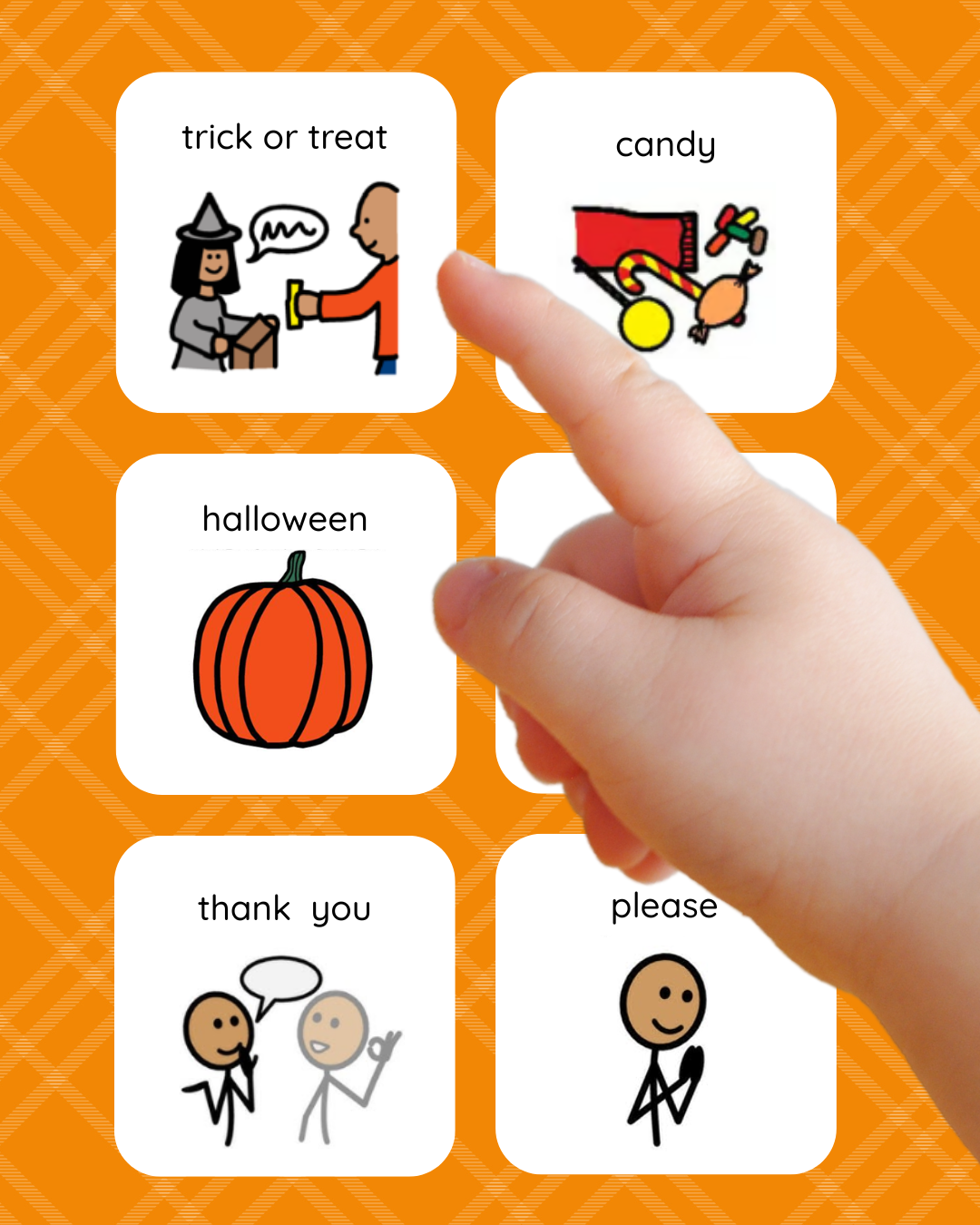
October is extra special — it’s AAC Awareness Month and Halloween! Whether they say ‘trick or treat’ with words, pictures, or a device, every child deserves to be heard. Here are some fantastic AAC resources that can help.

ABA Technician/Registered Behavior Technician


The KCC is seeking full and part-time techs/RBTs to join our ABA team.

  • ABA techs work one-on-one with children ages 2-6 who are experiencing autism spectrum disorders (ASD) or other language and learning challenges.
  • KCC programs utilize the principles and teaching procedures of applied behavior analysis/verbal behavior (ABA).
  • Our team of BCBAs provide the highest quality supervision and support to staff on a daily basis.
  • This is a fantastic opportunity to receive mentoring and practicum experience: many of our techs have moved on to become BCBAs, speech-language pathologists, and occupational therapists.
  • Those who are not yet accredited as a registered behavior technician (RBT) can work with our on-site coordinator to complete both initial and renewal modules.
  • Our bright, friendly state-of-the art clinic in West Bloomfield includes two buildings with individual classrooms, group spaces, and sensory gyms.

  • Provide direct therapy in individual and small group sessions to children of varying ability levels.
  • Play, engage, and teach children who may have challenging behaviors. They may be very active, may require full assistance with toileting, and may require physical prompting through some activities of the day.
  • Contribute to a productive and collaborative environment.
  • Communicate effectively/appropriately with staff, children, and parents.
  • Demonstrate a strong work ethic (attendance, time management).
  • Implement individualized treatment plan as written and directed by behavior analyst.
  • Attend all staff training sessions.
  • Demonstrate effective teaching procedures for discrete trial teaching and natural environment teaching
  • Complete documentation according to plan of care and in line with industry standards
  • Demonstrate effective strategies to minimize/de-escalate challenging behaviors.
  • Maintain confidentiality for all children and families.
  • Maintain and protect the safety and well-being of all children.

  • A four-year college degree is highly preferred in a related field such as psychology, child development, education, speech and language, etc. (ABA experience is preferred).
  • Able to take direction and tolerate coaching and feedback on a regular basis.
  • Able to remain calm and pleasant in a range of situations and under a variety of circumstances.
  • Self-motivated, wonderful with children, and have a desire to learn.

  • Must be able to play and engage with a young child up to six hours a day.
  • Literacy: Must be able to read written material from a variety of sources. Must be able to distinguish colors and view computer screen daily for several hours at a time.
  • Speaking/hearing: Must be able to communicate with staff, children, and parents on phone or in person. Must be able to receive information through oral communication.
  • Attention: Must be able to concentrate on work tasks despite distractions.
  • Stress tolerance: Must be able to exhibit self-control when with dealing children, families, or other clinic staff who become upset.

  • Enjoy an ideal schedule with no weekend or evening hours.
  • Choose full-time (40 hours per week) or part time (five mornings or five afternoons per week) to fit your needs.
  • You’ll be paid for your attendance, even if the child you work with is absent.
  • Same rate of pay if you’re working with a child or doing other tasks.
  • Medical, dental, and vision coverage (for full time staff, first of the month after 60 days)
  • Paid time off (after 90 days).
  • Monthly professional development days.
  • Training program to achieve registered behavior technician (RBT) accreditation.
  • Practicums are available.

Kaufman Children's Center for Speech, Language, Sensory-Motor & Autism Treatment is a leader in innovative treatment programs that help kids live their very best lives. The center is located in West Bloomfield, Michigan.

Our staff works together to create specialized programs for each child, especially those requiring more than one service. This team approach between departments maximizes kids' abilities to function at home, school, and in the community.

Kaufman Children’s Center provides equal employment opportunities to all qualified persons based on merit and qualifications, without regard to sex, race, color, religion, national origin, age, height, weight, marital status, pregnancy, disability, veteran status, genetic information, sexual orientation, gender identity, or any other classification or characteristic protected by law.

How to Apply

Please complete the form below to help us learn more about you

K-SLP Kit 1 Objects

Fun materials to enhance effectiveness of Kit 1 treatment cards


PHOTOS | VIDEOS | ORDER AT NORTHERN SPEECH

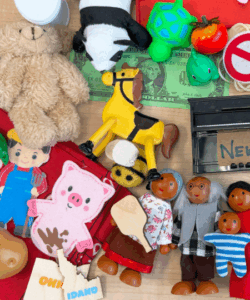
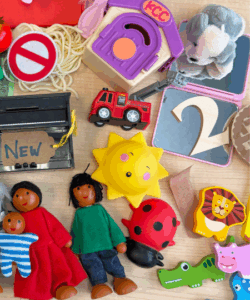
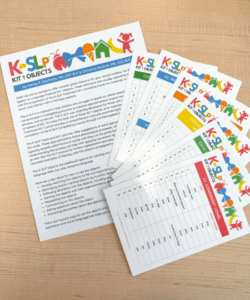
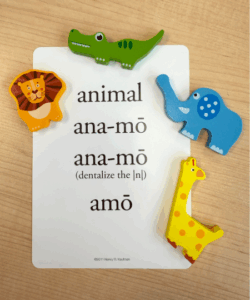
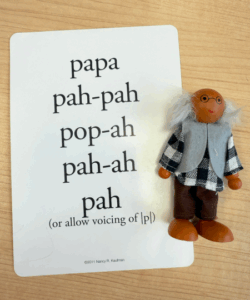
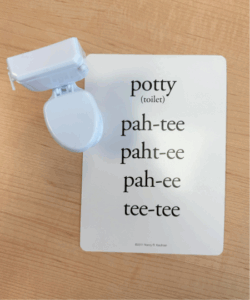
K-SLP Kit 1 Objects are another great resource for your clinical toolbox! These tangible, whimsical and visually appealing items are aligned with the syllable shapes from the K-SLP Treatment Kit 1 cards. They can be used to practice speech motor syllable sequences and expand expressive and receptive language, matching, and generalizing skills.

Manipulating the objects gives children a greater sensory experience, increasing the likelihood of frequent verbal expressions that can be shaped to improve speech intelligibility, expressive vocabulary, and syntax. In addition, auditory comprehension activities can easily be incorporated into therapy sessions to give children many opportunities to improve their ability to follow directions while manipulating the objects.

While the set was created for use with the Treatment Kit 1 cards, the objects can also enhance and supplement any speech and language training program by providing hands-on materials to interact with in therapy sessions.

Target age: 3-8 years.

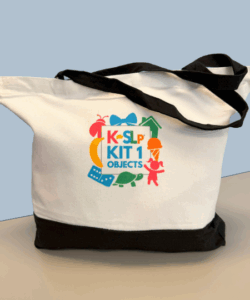
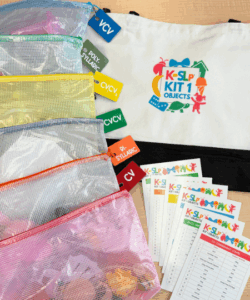
CONTENTS: Tote bag, 6 pouches with checklists, 81 objects

THERAPY TARGETS:

  • CVCV simple repetitive syllables: mom, dad, grandma, grandpa, baby, horse, dog, cow, sheep, chick, bird, owl, fire truck, barn
  • VC vowel-consonant / VCV vowel-consonant-vowel: googly eye, garbage can, ice cream, person, ant, bandage, house, apple, okay sign
  • CV consonant-vowel: sun, two, mirror, teacup, saucer, spoon, pea, bow, doll, no sign, ghost, bee, horse, shoelace, pie, tag
  • V1CV2 repetitive syllables with vowel change: mom, dad, baby, puppy, turtle, potato, banana, bubble container (empty)
  • 1V1C2V2 simple bisyllabics: honey stick, play money, pony, bunny, penny, sensory noodle, paddle, beetle, travel bottle, hippo, teddy bear, muddy pig, potty, panda, happy face, doll, marble, poodle, table, dinosaur, handle
  • CVCVCV simple polysyllabics: banana, potato, tomato, domino, bandana, Ohio, Idaho, 4 zoo animals (lion, alligator, elephant, giraffe), empty frame, piano

IDEAS FOR USE

  • Visually matching the objects to the corresponding picture.
  • Identifying and/or naming objects by function, feature, class, and location.
  • Following directions with the objects, including spatial.
  • Naming the objects with the best approximations, shaping toward perfection.
  • Requesting the objects.
  • Commenting on the objects.
  • Asking questions about the objects.
  • Answering absurdities about the objects (yes/no or either/or).
  • And many more!

Available from Northern Speech Services.

Kit 1 Object Photos

Tote bag

Pouches, tote bag, item lists

Objects

Objects

Information & object lists

Paired with K-SLP cards

Paired with K-SLP cards

Paired with K-SLP cards

Treatment Videos

Kit 1 Objects can be used in countless different ways! Here are a few examples of treatment sessions with speech-language pathologists from Kaufman Children's Center. We'll be adding more, so be sure to check this page soon or follow Nancy on Instagram, TikTok, or Facebook at @nancykaufmankslp.

Christina working with CVCV set

Christina working with C1V1C2V2 set

Lara working with C1V1C2V2 set

Nancy warming up with K-SLP cards

Nancy working on "go down" pivot phrase

Nancy working on "eat apple" pivot phrase

Teaching subject-verb-object phrases

References & Bibliography

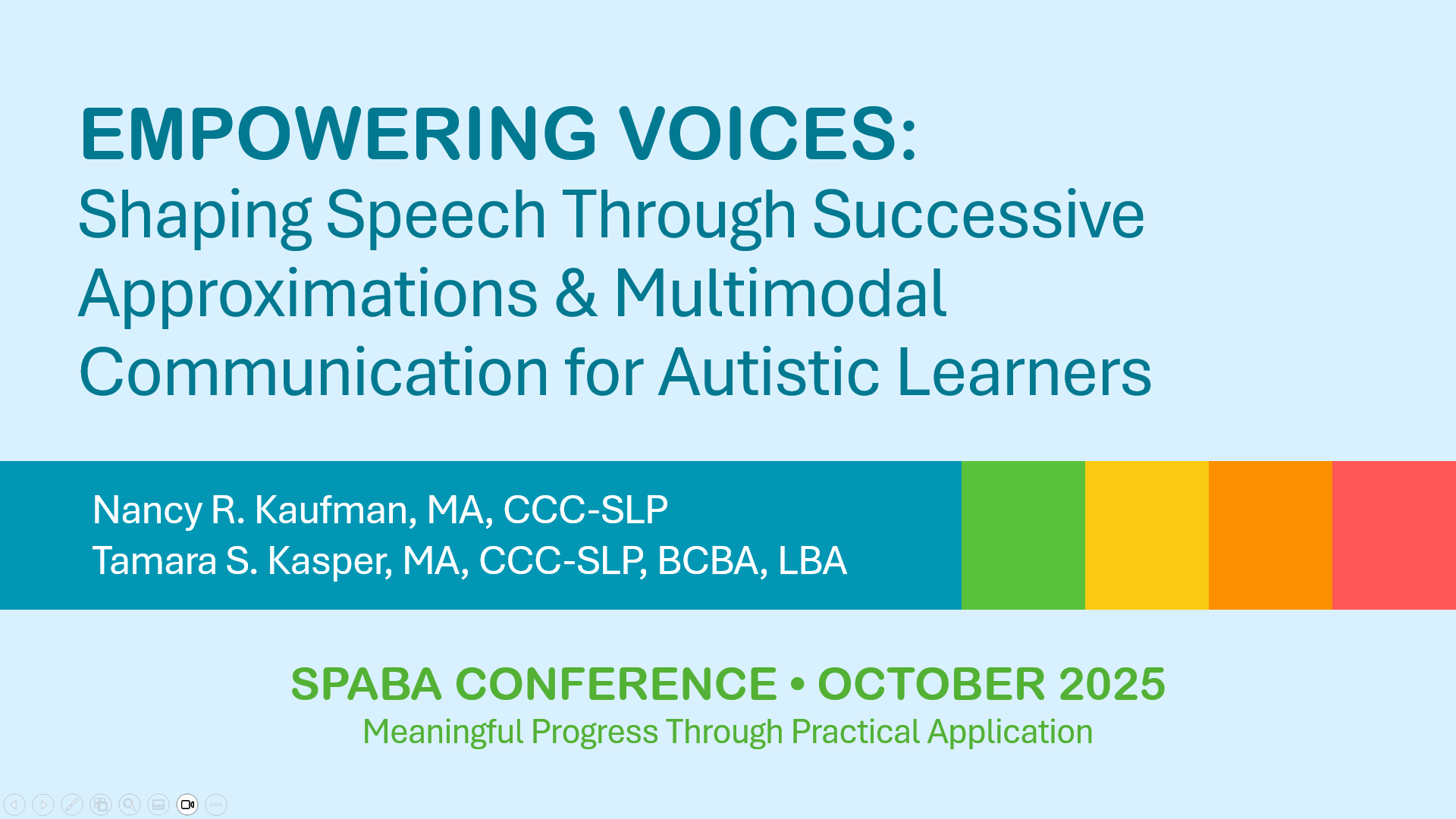
EMPOWERING VOICES:
Shaping Speech Through Successive Approximations
& Multimodal Communication for Autistic Learners
Nancy R. Kaufman, MA, CCC-SLP &
Tamara S. Kasper, MA, CCC-SLP, BCBA, LBA
SPABA Conference - October 2025


(listed alphabetically by author name)

THE VERBAL BEHAVIOR APPROACH: HOW TO TEACH CHILDREN WITH AUTISM AND RELATED DISORDERS
(Publication, 2007)
Barbera & Rasmussen
Jessica Kingsley Publishers: London 

INCREASING SPEECH SOUND PRODUCTION OF CHILDREN WITH AUTISM
(Presentation, 2012)
Carbone, V.
33rd Annual Conference of the Berkshire Association of Behavior Analysis
Amherst, MA

INCREASING THE VOCAL RESPONSES OF CHILDREN WITH AUTISM AND DEVELOPMENTAL DISABILITIES USING MANUAL SIGN MAND TRAINING
AND PROMPT DELAY
(Article, 2010)
Carbone, Sweeney-Kerwin, Attanasio & Kasper
Journal of Applied Behavior Analysis
43, 705-709

EFFECT OF TUTOR MODELED SUCCESSIVE APPROXIMATIONS VERSUS TUTOR MODELED ADULT FORMS TO IMPROVE TOPOGRAPHY OF TACTS
(Presentation, 2006)
Eldridge, Kasper & Godwin
International Convention of the Association for Behavior Analysis
Atlanta, GA 

EARLY ECHOIC SKILLS ASSESSMENT (EESA)
(Assessment, 2008)
Esch, B.

SPEECH AND LANGUAGE ASSESSMENT: A VERBAL BEHAVIOR ANALYSIS
(Article, 2010)
Esch, B., LaLonde, K., Esch, J.
Journal of Speech and Language Pathology – Applied Behavior Analysis
5 (2), 166-191

TREATING CHILDHOOD APRAXIA OF SPEECH WITH THE KAUFMAN SPEECH TO LANGUAGE PROTOCOL: A PHASE I PILOT STUDY
(Article, 2018)
Gomez, McCabe, Jakielski & Purcell
Language, Speech, and Hearing Services in Schools
49(3), 524-536

MELODIC INTONATION THERAPY
(Publication, 1989)
Helm-Estabrooks, Nicholas, & Morgan
Pro-Ed, Inc.: Austin, TX

EFFICACY OF THE KAUFMAN APPROACH IN INCREASING SPEECH OUTPUT WITH A LOW-VERBAL CHILD WITH AUTISM SPECTRUM DISORDER
(Presentation, 2013)
Holbrook, King & Pelayo
Department of Communication Sciences
& Disorders Graduate Symposium

Loma Linda University, CA 

THE SOCIAL ROLE OF IMITATION IN AUTISM: IMPLICATIONS FOR THE TREATMENT OF IMITATION DEFICITS
(Article, 2008)
Ingersoll, B.
Infants & Young Children
21(2), 107-119

THE DEVELOPMENT OF IMITATION IN INFANCY
(Article, 2009)
Jones, S.
Philosophical Transactions of the Royal Society B: Biological Sciences
364(1528), 2325-2335

PROGRESSIVE AND SYSTEMATIC SPEECH AND LANGUAGE TRAINING FOR CHILDREN ON THE AUTISM SPECTRUM - E133
(Online course, 2015)
Kasper, T.
Northern Speech Services, northernspeech.com

IMPROVING VOCAL VERBAL BEHAVIOR VIA TUTOR-MODELED SUCCESSIVE APPROXIMATIONS
(Presentation, 2003)
Kasper & Godwin
International Convention Association for Behavior Analysis
San Francisco, CA 

CHILDREN WHO STRUGGLE TO SPEAK? MOTIVATE, SIGN, CUE, & SCRIPT!
(Presentation, 2012)
Kasper & Kaufman
American Speech-Language-Hearing Association National Convention
Atlanta, GA

K&K SIGN/SELECT TO TALK
(Materials, 2025)
Kasper & Kaufman
Northern Speech Services
Gaylord, MI

USING PHONETIC HAND CUES TO PROMOTE SPEECH PRODUCTION SKILLS IN CHILDREN WITH LIMITED VOCAL REPERTOIRES
(Presentation, 2018)
Kasper & Slim-Topdijan
Women in Behavior Analysis Conference
Nashville, TN 

COMPETENCIES IN THE TREATMENT OF CHILDREN WITH APRAXIA OF SPEECH: THE KAUFMAN SPEECH TO LANGUAGE PROTOCOL (K-SLP)
(Online course, 2022)
Kaufman, N.
Northern Speech Services, northernspeech.com

KAUFMAN SPEECH PRAXIS TEST
(Assessment, 1995)
Kaufman, N.
Wayne State University Press
Detroit, MI

KAUFMAN K-SLP TREATMENT KIT 1 – BASIC LEVEL
(Materials, 1998)
Kaufman, N.
Northern Speech Services
Gaylord, MI

KAUFMAN K-SLP TREATMENT KIT 2 – ADVANCED LEVEL
(Materials, 2001)
Kaufman, N.
Northern Speech Services
Gaylord, MI

KAUFMAN K-SLP WORKOUT BOOK
(Materials, 2005)
Kaufman, N.
Northern Speech Services
Gaylord, MI

DIAGNOSING DEVELOPMENTAL VERBAL DYSPRAXIA: TEST DESIGN,
THEORY, AND PSYCHOMETRIC EVALUATION
(Publication, 1988)
Kaufman & Colquitt
The New Zealand Speech-Language Therapists’ Journal
43, 23-28

SLP-ABA: COLLABORATING TO SUPPORT INDIVIDUALS WITH COMMUNICATION IMPAIRMENTS
(Article, 2006)
Koenig & Gerenser
Journal of Speech and Language Pathology – Applied Behavior Analysis
1(1), 2-10

IMPLEMENTATION OF SPEECH GENERATING DEVICES (SGDs) USING A BEHAVIOR ANALYTIC FRAMEWORK
(Presentation, 2018)
Lindblad & Dower
National Autism Conference
Pennsylvania State University, PA

TRAUMATIC APHASIA
(Publication, 1970)
Luria, A.
Mouton & Co.: The Hague, Netherlands

PRINCIPLES OF MOTOR LEARNING IN TREATMENT OF MOTOR SPEECH DISORDERS
(Article, 2008)
Maas, E.
American Journal of Speech-Language Pathology
17(3), 277-298

BEHAVIORAL PRINCIPLES IN COMMUNICATIVE DISORDERS: APPLICATIONS TO ASSESSMENT AND TREATMENT
(Publication, 2016)
Maul, Findley & Adams
San Diego, CA: Plural Publishing

CONCEPTS AND PRINCIPLES OF BEHAVIOR ANALYSIS
(Publication, 1993)
Michael, J.
Society for the Advancement of Behavior Analysis: Kalamazoo, MI

ESTABLISHING OPERATIONS AND THE MAND
(Article, 1988)
Michael, J.
Analysis of Verbal Behavior
6, 3-9

THE MULTIPLE CONTROL OF VERBAL BEHAVIOR
(Article, 2011)
Michael, Palmer & Sundberg
Analysis of Verbal Behavior
27(1), 3-22

EFFECTIVENESS OF THE KAUFMAN SPEECH TO LANGUAGE PROTOCOL FOR CHILDREN WITH CHILDHOOD APRAXIA OF SPEECH AND COMORBIDITIES WHEN DELIVERED IN A DYADIC AND GROUP FORMAT
(Article, 2024)
Namasivayam, Cheung, Atputhajeyam, Petrosov, Branham, Grover, & van Lieshout
American Journal of Speech-Language Pathology

PREDICTORS OF FUNCTIONAL COMMUNICATION OUTCOMES IN CHILDREN WITH IDIOPATHIC MOTOR SPEECH DISORDERS
(Article, 2024)
Namasivayam, Shin, Nisenbaum, Pukonen & van Lieshout
Journal of Speech, Language, and Hearing Research
67(10), 4053-4068 

SHAPING SUCCESSIVE APPROXIMATIONS FOR SPEECH INTELLIGIBILITY: EFFECT UPON LANGUAGE
(Presentation, 2009)
Nancarrow, Kaufman & Burns
American Speech-Language-Hearing Association Annual Convention
New Orleans, LA 

COMPREHENSIVE SYNTHESIS OF EARLY INTENSIVE BEHAVIORAL INTERVENTIONS FOR YOUNG CHILDREN WITH AUTISM, BASED ON THE UCLA YOUNG AUTISM PROJECT MODEL
(Article, 2009)
Reichow & Wolery
Journal of Autism and Developmental Disorders
39(1), 23-41

IMITATION PERFORMANCE IN TODDLERS WITH AUTISM AND THOSE WITH OTHER DEVELOPMENTAL DISORDERS
(Article, 2003)
Rogers, Hepburn, Stackhouse & Wehner
Journal of Child Psychology and Psychiatry
44(5), 763-781

TREATING APRAXIA OF SPEECH IN ADULTS: THE DISORDER AND ITS MANAGEMENT
(Publication, 1984)
Rosenbek, J.
Grune & Stratton: Orlando, FL

ORAL PLACEMENT THERAPY FOR SPEECH CLARITY AND FEEDING
(Materials, 2009)
Rosenfeld-Johnson, S.
TalkTools Therapy
Charleston, SC

TALKTOOLS™ SPEECH TOOLS
(Materials)
Rosenfeld-Johnson, S.
Charleston, SC
talktools.com

TAKING YOUR CLIENT WITH ASD FROM NON-VOCAL TO VERBAL
Previously titled: Systematic approach to teaching speech to non-vocal individuals with autism
(Online course, 2012)
Roy-Hill & Solomon
TalkTools, talktools.com

EFFECTS OF AUGMENTATIVE AND ALTERNATIVE COMMUNICATION INTERVENTION ON SPEECH PRODUCTION IN CHILDREN WITH AUTISM: A SYSTEMATIC REVIEW
(Article, 2008)
Schlosser & Wendt
American Journal of Speech-Language Pathology
17(3), 212-230

TEACHING TOPOGRAPHY-BASED AND SELECTION-BASED VERBAL BEHAVIOR TO DEVELOPMENTALLY DISABLED INDIVIDUALS: SOME CONSIDERATIONS
(Article, 1993)
Shafer, E.
Analysis of Verbal Behavior
11, 117-113

VERBAL BEHAVIOR
(Publication, 1957)
Skinner, B.F.
Appleton-Century-Crofts: New York, NY

THE RELATIONSHIP OF PRACTICE AND REPETITION TO MOTOR LEARNING FOR SPEECH IN CHILDREN WITH APRAXIA
(Online article, 2005)
Strand, E.
Apraxia Kids
apraxia-kids.org

EASY DOES IT® FOR APRAXIA AND MOTOR PLANNING
(Materials, 1994)
Strode & Chamberlain
linguisystems.com

SELECTING A RESPONSE FORM FOR NONVERBAL PERSONS: FACILITATED COMMUNICATION, POINTING SYSTEMS, OR SIGN LANGUAGE?
(Article, 1993)
Sundberg, M.
Analysis of Verbal Behavior
11, 99-116

TEACHING LANGUAGE TO CHILDREN WITH AUTISM OR OTHER DEVELOPMENTAL DISABILITIES
(Publication, 1998)
Sundberg & Partington
Behavior Analysts, Inc.: Pleasant Hill, CA

COMPARING TOPOGRAPHY-BASED VERBAL BEHAVIOR WITH STIMULUS SELECTION-BASED VERBAL BEHAVIOR
(Article, 1990)
Sundberg & Sundberg
Analysis of Verbal Behavior
8(1), 31-41

IMPROVING THE SPEECH PRODUCTION OF CHILDREN WITH AUTISM
(Presentation, 2006)
Sweeney, Zecchin, Carbone, Janeckey, Draper & McCarthy
Association for Behavior Analysis Conference
Atlanta, GA 

INDUCING VOCAL VERBAL BEHAVIOR IN CHILDREN WITH SEVERE LANGUAGE DELAYS THROUGH RAPID MOTOR IMITATION RESPONDING
(Article, 2003)
Tsiouri & Greer
Journal of Behavioral Education
12(3), 185-206

ENHANCING THE APPLICATION AND EVALUATION OF A DISCRETE TRIAL INTERVENTION PACKAGE FOR ELICITING FIRST WORDS IN PREVERBAL PRESCHOOLERS WITH ASD
(Article, 2012)
Tsiouri, Schoen & Paul
Journal of Autism and Developmental Disorders
42(7), 1281-1293

ACQUISITION OF MANDS, TACTS, AND INTRAVERBALS THROUGH SIGN EXPOSURE IN AN INDIVIDUAL WITH AUTISM
(Article, 2011)
Valentino & Shillingsburg
Analysis of Verbal Behavior
27(1), 95-101

PHONOLOGICAL PROCESS ANALYSIS
(Publication, 1979)
Weiner, F.
University Park Press: Baltimore, MD

CRITICAL ISSUES IN EARLY LANGUAGE TRAINING USING AUGMENTATIVE AND ALTERNATIVE COMMUNICATION IN AUTISM SPECTRUM DISORDERS
(Presentation, 2018)
Wendt & Weber
ASHA SIG Conference
Boston, MA

TOPOGRAPHY-BASED AND SELECTION-BASED VERBAL BEHAVIOR: A FURTHER COMPARISON
(Article, 1991)
Wraikat, Sundberg & Michael
Analysis of Verbal Behavior
9, 1-17

updated 9/10/25