K-SLP Myths

Truths behind popular misconceptions about the K-SLP method


Click on the myth to read the truth from Nancy R. Kaufman, MA, CCC-SLP

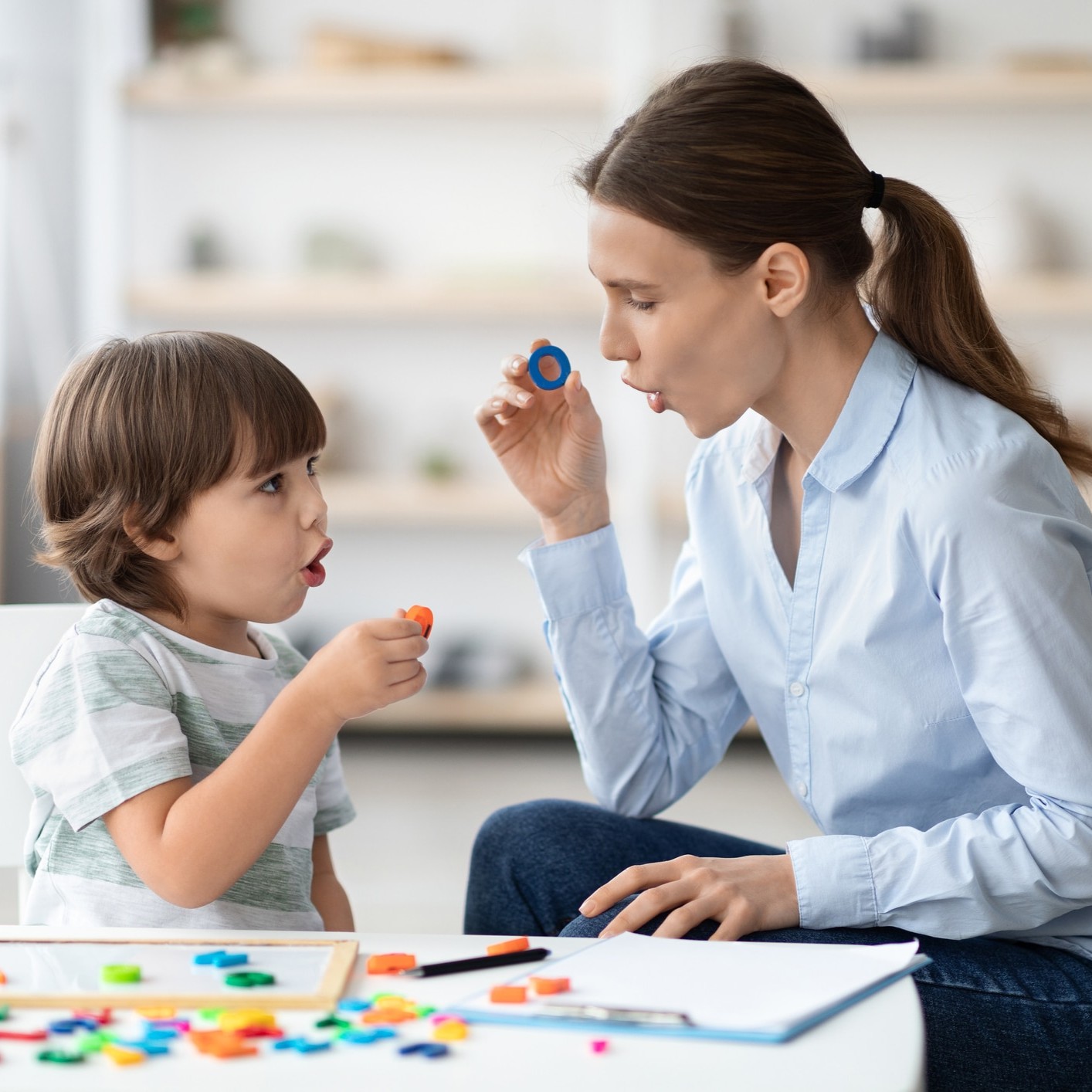
TRUTH: The K-SLP is not just a drill-oriented method. It is not just about the picture cards in Kits 1 and 2. Play is incorporated into every session. Picture cards are initially implemented, as it is too difficult to contrive the specific targets for the child to be able to practice the specific vowels, consonants, and syllable shapes with enough repetition necessary for success.

If the SLP is only using the Kit pictures within a session, they are not implementing the K-SLP the way it was intended! Sessions can and eventually should be conducted without any pictures at all. For very young children, pictures are not introduced until the task of imitation is understood, and there are always targeted goals through play.

Practicing new skills through play and the natural environment is essential to the K-SLP methods. The K-SLP is implemented with high levels of motivating toys and activities in a warm, encouraging manner. Many responses are necessary for success. Therefore, you will see a great deal of repetition in a K-SLP session.

If the K-SLP is done the way in which it was intended, the children will be willing, cooperative and successful learners.


TRUTH: It's a misconception that kids with CAS should only be taught the full, adult forms of words. The K-SLP effectively involves teaching word approximations toward target words, phrases and sentences, and not simply just accepting the child’s approximation. Word approximations are continuously shaped toward the full target words to perfection.

Once the child learns a closer approximation of a target word, the old approximation is extinguished and only the closer approximation is reinforced. Full correct words and phrases are always modeled for the child. If the child is not stimulable to produce a vowel or consonant accurately, they would be taught a compensatory placement, while continuing to gain stimulability for articulatory accuracy.

There is a great deal of research supporting teaching a new behavior (in this instance, the behavior of producing and combining vowels and consonants to form words, and combining words to formulate language) through shaping successive approximations. (See the list of evidence-based practice).

Every child Nancy Kaufman or any SLP at the Kaufman Children’s Center has ever taught to develop effective vocal communication was taught via successive word approximations and compensatory articulatory placements. The K-SLP methods have been implemented successfully since 1979.


TRUTH: Due to the nature of the K-SLP, it is difficult to systematize the process so each clinician is using the exact same intervention strategies. The protocol depends upon a wide range of variables including:

  • The individual clinician
  • How cues are chosen
  • How motivation and reinforcement is implemented
  • How to simplify the motor plans of words temporarily based upon the child’s repertoire

However, a great deal of evidence and peer-reviewed research has been completed. You can find a list of resources HERE.


TRUTH: There are many controversies surrounding “oral-motor therapy.” The research has taught us that oral-motor exercises do not help children to be more successful vocal communicators if they are exhibiting only characteristics of CAS. We do not implement oral-motor exercises at all for this population of children.

Specific tools established and offered through TalkTools and Apraxia Shapes have been instrumental for those who have very few vowels or consonants within their repertoire and who struggle with the underlying oral placement to sustain the accuracy of a vowel or consonant. When appropriate, a tool will be implemented inside the oral cavity to assist the child as a cue (much like how PROMPT cues are used outside of the oral cavity) for initial success, then the tool is faded out as the child is able to produce the underlying movement to sustain the new vowel or consonant independently.

TalkTools and Apraxia Shapes are also implemented here at the KCC to assist with the quality of feeding for those children who struggle with sucking, chewing and swallowing, and who also struggle to speak. Horns and/or straws are only introduced to gain the necessary skills for improved feeding or as a tool to gain a vowel or consonant as above. Sometimes, horns are introduced to help the child to practice sustaining respiratory support that would be needed to support sentence length or as a tool to be paired directly with a consonant that requires sustaining and grading air flow such as for /s, f, sh/.


TRUTH: K-SLP materials are not essential for successful K-SLP methods. They were produced by Nancy as she needed/wanted them for stimuli and assumed that other SLPs might also find them to be useful.

If SLPs understand the K-SLP methods, all that is needed are pictures, objects, toys, and other highly preferred items or activities for each child. Each SLP will also require knowledge about how to simplify the motor plans of words by implementing natural phonological processes and understanding shaping methods.

Visit Northern Speech Services for a 6-hour course on the full K-SLP method (ASHA credits available).


CONTACT

We're here to help!
Reach out with questions
K-SLP Research & Clinical Excellence

A Message from Nancy R. Kaufman, MA, CCC-SLP

Parents understandably want the very best for their children, and they are inundated with information about different types of therapy. In the search for the best approach, we often look for proof, and I am often asked about the research behind the Kaufman Speech to Language Protocol (K-SLP). We’d like to take some time to address this.

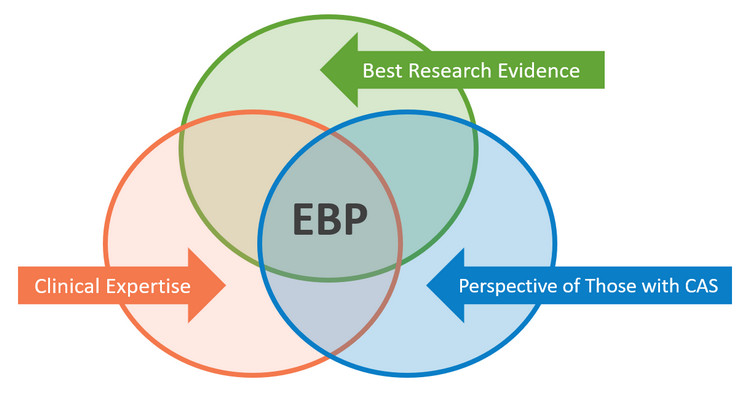
I value research and respect the professionals whose intentions are to determine what constitutes best practices for those with childhood apraxia of speech (CAS). However, it is important to consider the expertise of the clinician who is on the front lines, working with children daily, yielding years of experience with what we know works. Clinical experience is just as important as research.

The best evidence informed practice consists not only of researched evidence, but also of clinical expertise and the parent’s satisfaction of their child’s treatment:

Research on Childhood Apraxia of Speech

Here are some thoughts about research from our friends at Apraxia Kids.

Most of our treatment research with children who have CAS is based on small sample sizes (i.e., small numbers of patients). That said, this research has still given some answers about the best approaches for working with children who have CAS. By looking at the “evidence” a speech/language pathologist can determine which approaches are most likely to work and which approaches to avoid.  

Apraxia Kids

We also must ask ourselves, since research is an ongoing process how do we address the needs of children who may not be benefiting from a protocol with a higher level of research.  This is a real concern and one that needs to be addressed.  Here is Apraxia Kids’ position on this matter.

Sometimes clinicians have to use professional experience and opinion combined with the available research to try something slightly different, particularly if the approaches with the strongest “evidence-base” aren’t working for a child. Clinicians have to monitor progress and adapt when a child is not meeting her/his goals and objectives. The approach should still have some evidence base – even if it’s minimal. Evidence base includes knowledge of theoretical foundations of how children learn, how speech production works. Based on this knowledge, clinicians can generate ideas/hypotheses (sophisticated educated guesses) about what might work for a given child.

Apraxia Kids

With that in mind, we must understand that just because an approach has been researched with positive results does not mean approaches that have not been researched are at all inferior. What is important is that the approach follows best practices found within the most-current research.

The K-SLP was developed in the early 1980’s. This was during the time when research was just beginning regarding CAS. However, it is exciting to find that the K-SLP has been following the most current research on CAS since its inception. The K-SLP has never been a stagnant method. It continues to evolve whenever new research calls for changes or updates in how techniques are implemented.

The K-SLP is rooted in the principles of behavior learning, which have existed since the 1950s and mirror current research for the principles of motor learning:

  • Establishing a behavior that doesn’t exist
    Example: gaining vocal imitation or gaining an increase of isolated vowels or consonants
  • Improving upon a behavior that does exist
    Example: helping children to have improved speech clarity to use functionally for expressive language
  • Extinguishing behaviors that are interfering to the process
    Example: adding schwa, adding extra vowels or syllables
  • Behavior management
    Example: eliminating behaviors interfering with progress in therapy

Specifically for CAS, the K-SLP methods include the following:

  • Choosing target words on the basis of the child’s vowel and consonant repertoire and determining best approximations toward perfection of words that will provide the child with functional communication, starting with single words
  • Implementing and fading multisensory cues (visual, auditory, tactile/proprioceptive)
  • Implementing different practice schedules (massed, distributed, etc.) to facilitate target words and phrases
  • Implementing errorless teaching (cueing before failure)
  • Mixing and varying tasks to avoid teaching overgeneralization
  • Using reinforcement strategically, according to the child’s interests and needs
  • Coaching parents and caregivers through play and natural environment teaching

The K-SLP materials were created out of a necessity arising from clinicians who have been implementing these methods. Although the materials were originally created for clinicians, they have been found to be effective for parents when instructed by the SLP. Coaching parents through play and the natural environment is inherent to the K-SLP.


Children from the United States and over a dozen other countries have become effective vocal communicators with the K-SLP methods. While we continue researching treatment approaches, we are all attempting to clearly define CAS.  As a clinician I have looked at speech-motor skills on a continuum and do feel there are levels of severity for CAS.  I maintain that this will be validated.

K-SLP Success Stories

Below you can watch videos of children with varying degrees of CAS who have made significant progress. This is due to the team effort between me and their SLP teams, parents, family members, and caregivers…as well as the children's own hard work!

Jason’s Progress

John O’s Progress

John S’s Progress

Josie’s Progress


View More Videos

Click below for the before-and-after videos of more kids!

We will be posting a few additional videos per month. If you have not seen your child’s videos, it is possible that they are scheduled to be showcased at a later time, or we may not have been able to locate early videos.

We would love to hear about your child's success with the K-SLP methods. Please contact us.

K-SLP Research

Application for childhood apraxia of speech and autism spectrum disorder


(listed most recent to least recent)

EFFECTIVENESS OF THE KAUFMAN SPEECH TO LANGUAGE PROTOCOL FOR CHILDREN WITH CHILDHOOD APRAXIA OF SPEECH AND COMORBIDITIES WHEN DELIVERED IN A DYADIC AND GROUP FORMAT
(Publication, 2024)
Namasivayam, Cheung, Atputhajeyam, Petrosov, Branham, Grover, & van Lieshout
American Journal of Speech-Language Pathology

KAUFMAN SPEECH TO LANGUAGE PROTOCOL FOR CHILDHOOD APRAXIA OF SPEECH
(Poster, 2024)
Namasivayam, Branham, Cheung, & Grover
Speech-Language & Audiology Canada Conference
Vancouver, BC, Canada

KAUFMAN SPEECH TO LANGUAGE PROTOCOL FOR CHILDREN WITH CHILDHOOD APRAXIA OF SPEECH: PHASE II DATA
(Presentation, 2023)
Namasivayam, Branham, Atputhajeyam, Lysenko, Cai, Elsayed, & Grover
American Speech-Language-Hearing Association Annual Convention
Boston, MA

A SINGLE CASE EXPERIMENTAL DESIGN STUDY USING AN OPERATIONALIZED VERSION OF THE KAUFMAN SPEECH TO LANGUAGE PROTOCOL FOR CHILDREN WITH CHILDHOOD APRAXIA OF SPEECH
(Publication, 2023)
Gomez, Purcell, Jakielski, McCabe
International Journal of Speech-Language Pathology

DATA-DRIVEN TREATMENT PATHWAY FOR CHILDREN WITH MOTOR SPEECH DISORDERS
(Presentation, 2023)
Namasivayam, A.K.
ABRAPRAXIA National Conference on Childhood Apraxia of Speech
Sao Paulo, Brazil

EFFECTIVENESS OF KAUFMAN SPEECH TO LANGUAGE PROTOCOL FOR CHILDREN WITH CHILDHOOD APRAXIA OF SPEECH AND COMORBIDITIES
(Presentation, 2023)
Namasivayam, Branham & Grover
Apraxia Kids National Conference
Plano, TX

WHAT PREDICTS FUNCTIONAL COMMUNICATION OUTCOMES IN CHILDREN WITH CAS AND SPEECH MOTOR DELAY
(Presentation, 2023)
Namasivayam, Shin, Nisenbaum, Pukonen, Sue, Choy, & van Lieshout
Apraxia Kids National Conference
Plano, TX

PREDICTORS OF FUNCTIONAL COMMUNICATION OUTCOMES IN CHILDREN WITH IDIOPATHIC MOTOR SPEECH DISORDERS
(Publication, 2023)
Namasivayam, Shin, Nisenbaum, Pukonen & van Lieshout
Journal of Speech, Language, and Hearing Research

DATA-DRIVEN CARE PATHWAY FOR CHILDREN OVER 36 MONTHS OF AGE WITH MOTOR SPEECH DISORDERS
(Presentation, 2022)
Namasivayam, Pukonen & van Lieshout
International Conference on Speech Motor Control
Groningen, the Netherlands

TREATING CHILDHOOD APRAXIA OF SPEECH WITH THE KAUFMAN SPEECH TO LANGUAGE PROTOCOL: A PHASE 1 PILOT STUDY
(Publication, 2018)
Gomez, McCabe, Jakielski, & Purcell
Language, Speech, and Hearing Services in Schools

BRIDGING THE GAP BETWEEN SPEECH AND LANGUAGE: USING MULTIMODAL TREATMENT IN A CHILD WITH APRAXIA
(Publication, 2016)
Tierney, Pitterle, Kurtz, Nakhla, & Todorow
Pediatrics 

EFFICACY OF THE KAUFMAN APPROACH IN INCREASING SPEECH OUTPUT WITH A LOW-VERBAL CHILD WITH AUTISM SPECTRUM DISORDER
(Presentation, 2013)
Holbrook, King & Pelayo
Department of Communication Sciences and Disorders Graduate Research Symposium
Loma Linda University, CA

INTENSIVE CAS SUMMER PROGRAM: BOOST OR BUST?
(Poster, 2013)
Nancarrow, Kaufman, & Ficker
American Speech-Language-Hearing Convention
Chicago, IL

APRAXIA OF SPEECH IN CHILDREN AND ADOLESCENTS: APPLICATION OF NEUROSCIENCE TO DIFFERENTIAL DIAGNOSIS AND INTERVENTION
(Publication, 2011)
Burns, M.
Perspectives on Neurophysiology and Neurogenic Speech and Language Disorders

INCREASING THE VOCAL RESPONSES OF CHILDREN WITH AUTISM AND DEVELOPMENTAL DISABILITIES USING MANUAL SIGN MAND TRAINING AND PROMPT DELAY
(Publication, 2010)
Carbone, Sweeney-Kerwin, Attanasio, & Kasper
Journal of Applied Behavior Analysis

SHAPING SUCCESSIVE APPROXIMATIONS FOR SPEECH INTELLIGIBILITY: EFFECT UPON LANGUAGE
(Presentation, 2009)
Nancarrow, Kaufman, & Burns
American Speech-Language-Hearing Association Annual Convention
New Orleans, LA

EFFECT OF TUTOR-MODELED SUCCESSIVE APPROXIMATIONS VERSUS TUTOR-MODELED ADULT FORMS TO IMPROVE TOPOGRAPHY OF TACTS
(Presentation, 2006)
Eldridge, Kasper, & Godwin
International Convention of the Association for Behavior Analysis
Atlanta, GA

IMPROVING THE SPEECH PRODUCTION OF CHILDREN WITH AUTISM
(Presentation, 2006)
Sweeney, Zecchin, Carbone, Janeckey, Draper, & McCarthy
Association for Behavior Analysis Conference
Atlanta, GA

IMPROVING VOCAL-VERBAL BEHAVIOR VIA TUTORED-MODELED SUCCESSIVE APPROXIMATIONS
(Presentation, 2003)
Kasper & Godwin
International Convention Association for Behavior Analysis
San Francisco, CA

Updated 2/19/25

K-SLP Research & Clinical Excellence

Special Message from Nancy Kaufman

LEARN MORE

K-SLP & Autism Spectrum Disorder

Methods that act as a bridge to vocal communication


There are many children with autism spectrum disorders who are not vocal verbal communicators. It is difficult to determine whether or not CAS is the causal factor. Nevertheless, best practices for CAS are also best practices for these children. Very often, however, the child may not clearly understand the task of producing isolated vowels and consonants. They may not yet be able to imitate behavior in general.

Here are specific methods that have been developed by speech-language pathologists and others to help this special population.

These techniques are used to provide tactile/sensory cues so a child is able to find the correct oral placement or posture to produce sounds they are not yet able to directly imitate.

LEARN MORE HERE

Renee Roy Hill's Apraxia Shapes are ideal for transitioning kids with motor-planning deficits from oral placement activities to speech production.

LEARN MORE HERE

Rapid Motor Imitation Antecedent training effectively uses behavioral momentum to gain first words for many children with autism who struggle to speak. This method is used in our ABA program with input from our SLPs.

LEARN MORE HERE

Sign/Select to Talk, authored by Tamara Kasper and Nancy Kaufman, is a method to bridge sign language to vocal skills especially for children with ASD who struggle to speak.

LEARN MORE HERE


CONTACT

We're here to help!
Reach out with questions
K&K Sign/Select to Talk

Selecting and shaping vocal language for complex communication needs


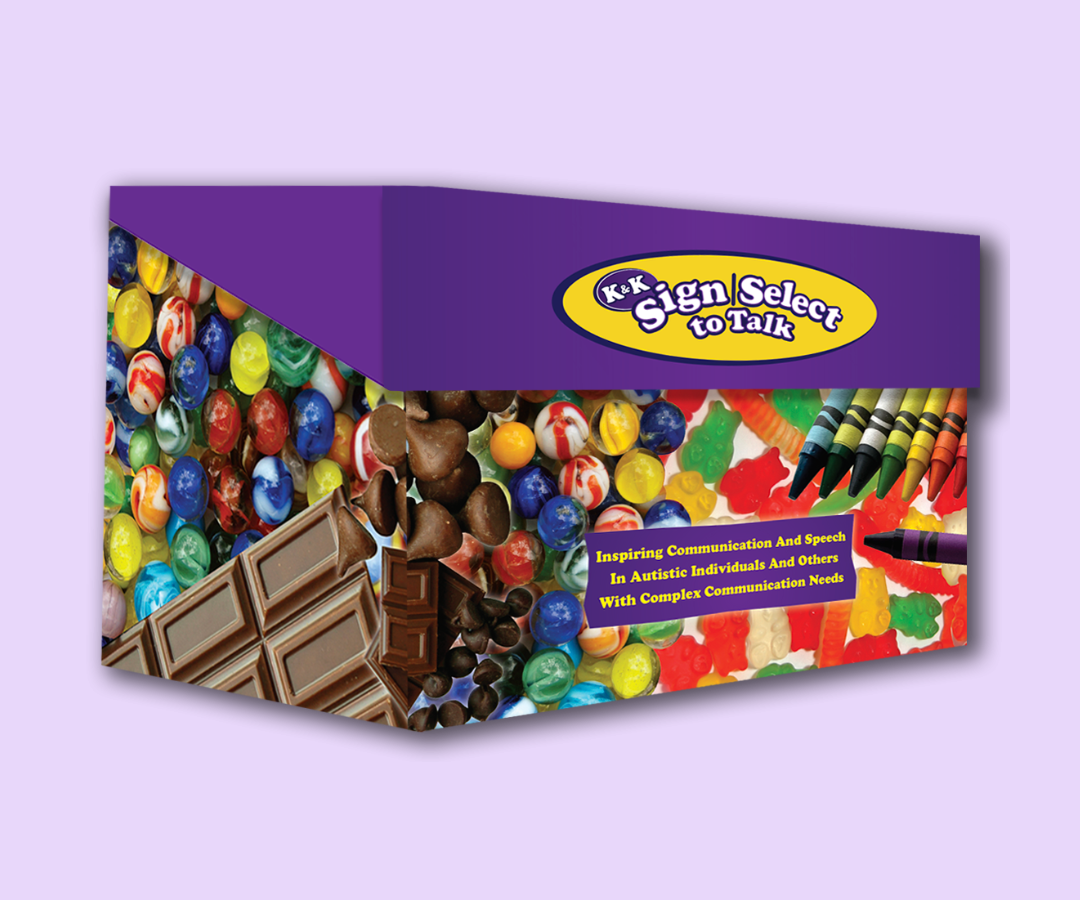
Created by Nancy Kaufman and Tamara Kasper, K&K Sign/Select to Talk builds communication and speech in autistic individuals and others with complex communication needs. It is designed specifically for learners and their treatment teams who use multimodal communication to teach requesting with unaided AAC systems (gestures or signs) or with aided AAC systems (picture exchange or speech generating devices). Concurrent with AAC instruction, this approach uses Kaufman K-SLP successive word approximations to improve the functional clarity of verbal vocal production of the items and actions being requested.

  • Includes over 200 vocabulary cards representing everyday foods, drinks, toys, and activities that learners frequently request and find motivating.
  • Vocabulary items were selected to meet the unique generalization and motivational needs of autistic individuals.
  • Each target item or action is represented by an engaging photograph on a large, glossy 5"x7" card.
  • Photographs were selected for iconicity and to aid in transfer of skills across different language functions.
  • The reverse side of each card features Kaufman "word shell" successive approximations to assist in improving verbal vocal production.
  • Also included is a description of the sign (ASL) for that target item with pictures of the hand shapes.
  • The accompanying 50-page manual fully explains this approach.

Ages 2 to 12 years.

Published by Northern Speech Services.


K-SLP Test & Materials

K-SLP products, video demonstrations, and where to buy


The K-SLP treatment materials began with the Kaufman Speech Praxis Test, through which SLPs can take data through imitation of which vowels, consonants, and syllable shapes are within the child’s repertoire, and to provide a systematic plan of care.

The additional materials help those with CAS combine vowels and consonants to form the simple syllable shapes, and progress on to more complex words and to combine words to formulate expressive language for effective vocal/verbal communication.

K-SLP materials are sold by Northern Speech Services. Links to purchase are available on each product page below.

CONTACT

We're here to help!
Reach out with questions
Speech Praxis Test

KSPT aids in the diagnosis and treatment of childhood apraxia of speech

LEARN MORE

Treatment Kit 1

Teaches children to combine consonants and vowels to form words

LEARN MORE

Treatment Kit 2

Refines intelligibility for children who have mastered sounds in Kaufman Kit 1

LEARN MORE

Workout Book

After the kits, the workout book expands single words into phrases and sentences

LEARN MORE

K&K Sign/Select to Talk

Selecting and shaping vocal language for complex communication needs

LEARN MORE

Kit 1 Objects

Fun, tangible items that enhance the effectiveness of the Treatment Kit 1 cards

LEARN MORE

K-SLP Teaching Strategies

Combining principles of applied behavior analysis and motor learning


Childhood apraxia of speech requires specific treatment techniques for successful outcomes. Many teaching strategies of applied behavior analysis (ABA) and more specifically, applied verbal behavior (AVB) are aligned with the most current research in CAS. Combined with the principles of motor learning, they provide an effective framework for solid clinical practice to help those with CAS to become effective vocal communicators.

The K-SLP methods follow these best practices and are implemented here at KCC.

Clearly define the behavior that is desired to be established, improved upon, or extinguished.

In this case, it would be to establish vowels and consonants that are not within the child’s repertoire, establish the combinations of vowels and consonants to create syllable shapes/words, or establish the ability to connect words and move into grammatical skills.

Behaviors to extinguish might include the child erroneously adding a schwa “uh” post final consonants. The child might be adding erroneous vowels, consonants, or syllables to words. They also may use filler non-speech vocalizations rather than the new skills that they have developed, to name a few.


Determine the child’s highly preferred toys and activities and have them readily available.

Then, understand how to use these highly preferred items to reinforce the skill areas being taught, providing feedback as to whether or not the utterance was correct, incorrect or getting closer to the target.


Cue before failure. It is important to know the child’s error patterns so they are assisted before making the error and can be reinforced for successes.


Understand how to shape successive approximations of words toward the ultimate goal of perfect articulation.

Many children are not stimulable for the consonants and vowels that are contained in words that are important for them to learn. They will need compensatory placements for some (an easier way to produce complicated consonants or vowels), and simplification of the motor plan for others.

This is where phonological processes are implemented to simplify the motor plan and shape toward the target.


Mix and vary the tasks so as to not actually teach over generalization. This also involves the principles of motor learning, blocked vs. random practice for retention of the skills to be maintained.


Gain as many responses as possible during a session on each goal.


Help the child to use new behaviors functionally in their natural environment. Provide supports to remember new skills and continue to cue speech motor while also scripting language through play. Contrive the environment to provide more opportunities to practice.


1369596152

CONTACT

We're here to help!
Reach out with questions
Notes from Nancy

Clinical speech and language collaborations


Working with kids with childhood apraxia of speech and other speech sound disorders can be challenging! Nancy Kaufman offers collaboration with groups to determine goals and treatment techniques for individual children on your caseload. It is appropriate for the speech and language staff of:

  • School districts
  • Private practices
  • Hospital clinics
  • Any SLP group working with kids with childhood apraxia of speech

COLLABORATION RATE: $2,000 (USD)

Prior to the consultation date, Nancy will review up to 5 video recordings of full therapy sessions. A summary of each child's treatment and/or most-recent report is required, including goals that you are working on as well as those that the child has already met. Video footage must be received no less than one week before the collaboration date.

On the scheduled date, Nancy will meet online with your staff to determine goals and treatment techniques for each of the children reviewed (2 hours total) and answer any questions (30 minutes).

The host organization is responsible for:

  • Setting up the virtual meeting and inviting participants
  • Any meeting-related tech support
  • Managing any continuing education credits

All staff members involved in the collaboration should complete Competencies in the Treatment of Children with Apraxia of Speech: The Kaufman Speech to Language Protocol, available through northernspeech.com.

If you are interested in scheduling a collaboration with Nancy Kaufman, please email Cyndi Davis, outreach coordinator.

CONTACT

Email Cyndi Davis with
questions or to schedule

Online Courses with Nancy Kaufman

Learn K-SLP methods with courses you can complete at your own pace


Visit the links provided to access content. Some courses require a membership or fee.

This 6-hour online course focuses on evaluation and treatment strategies for childhood apraxia of speech (CAS) using the Kaufman Speech to Language Protocol methods.

The presentation includes signs and symptoms of CAS, establishing motivation, shaping word approximations, implementing and fading cues, reinforcement strategies, data collection, scripting functional expressive language, coaching parents, and practicing skills in the natural environment. Also discussed is implementing the principles of motor learning for practice schedules, and how to move from the acquisition stage to the retention stage of learning to be an effective vocal communicator.

The methods, strategies, and techniques presented in this course follow the most current research in CAS and provide clinicians with the information they need to help children progress from a simple core vocabulary to phrases and eventually to sentences and conversational speech. Therapy session videos are shown throughout the presentation to enhance the learning experience.

Focus is on children ages 2-6 years. Offered for 0.6 ASHA CEUs.

COURSE AVAILABLE FROM NORTHERN SPEECH SERVICES


The competency course combines Nancy Kaufman's 6-hour K-SLP overview with three new expert-level courses on the following subjects:

  1. Strategic selection of practice words and phrases in childhood apraxia of speech
  2. Framing techniques to achieve clinical excellence in CAS therapy
  3. Clinical mistakes in the treatment of CAS and what to consider instead

Clinicians who successfully complete this course will demonstrate proficiency in the K-SLP, which is the most-used method for CAS treatment in the United States.

Offered for 1.0 ASHA CEU (10 hours of content)

COURSE AVAILABLE FROM NORTHERN SPEECH SERVICES


Children with childhood apraxia of speech (CAS) require cues to help them to remember the upcoming consonants, vowels, and syllables of practice words. They also often need help to combine words to formulate phrases and sentences by following scripts that they can retain and implement spontaneously.

This webinar will overview how cues and scripts can assist children with CAS to become successful vocal communicators. Cueing and scripting techniques will be overviewed and presented via video.

COURSE AVAILABLE FROM APRAXIA KIDS


It is often difficult to motivate children with childhood apraxia of speech (CAS) to practice at home or even to cooperate within a therapy session.  This webinar will offer suggestions to maximize practice through play.

  • Parents and caregivers are coached to pair themselves with fun toys and activities, making the speech and language practice activities highly preferred, exciting and successful.
  • Therapy materials are implemented as well, though paired with play activity.
  • Kaufman Speech to Language Protocol (K-SLP) methods of cueing motor-speech and scripting functional expressive language to include the language of toys and games will be emphasized.
  • Fading cues and scripts as well as teaching successive approximations toward target words and phrases is taught. 

COURSE AVAILABLE FROM APRAXIA KIDS


Come along for a FREE parent presentation! This virtual event was was hosted by the Parish School and Carruth Center in Houston, TX where Nancy normally visits once a year to consult. This year she was grounded due to COVID-19 restrictions, but that didn't stop her from connecting online for an instructive and entertaining presentation on childhood apraxia of speech. Good news for everyone - our friends at Parish and Carruth recorded the session so you can watch too.

COURSE AVAILABLE ON YOUTUBE


Nancy R. Kaufman is excited to offer this complimentary one-hour course for parents! Included is a wealth of information of what Nancy has learned to be effective therapy for CAS from over 40 years of experience.

COURSE AVAILABLE ON YOUTUBE

Click HERE for a printable list of fun, therapeutic activities you can do at home with your child.


Questions

Contact Cyndi Davis

Live Courses with Nancy Kaufman

Virtual courses for current professionals and professionals of tomorrow


K-SLP Course for Professional Groups

Full Kaufman Speech to Language Protocol overview for clinics, schools, and organizations

LEARN MORE

Clinical & CAS Course for Students

Clinical and childhood apraxia of speech course for tomorrow's SLPs

LEARN MORE