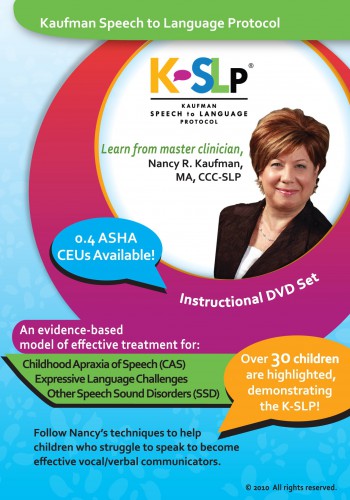
The K-SLP Instructional DVD Set

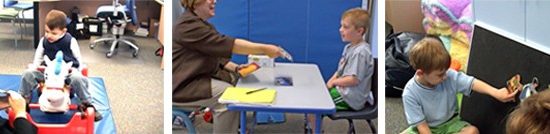
This DVD set overviews the Kaufman Speech to Language Protocol, an evidence-based model of effective treatment for childhood apraxia of speech. Watch Nancy interact with over 30 children of varying ages and abilities over four hours and three DVDs. Learn the basis of the K-SLP approach and how to successfully employ its strategies to increase speech intelligibility.


Nancy’s 30+ years of experience and expertise is clearly demonstrated in the presentation, which is geared toward professionals, parents, and caregivers. Owning this DVD set will allow you to revisit the techniques time and time again, and refer to specific children who remind you of the kids in your life who would benefit from these techniques. Never before has there been a “how to” DVD produced with this degree of experience, specific examples of techniques, and the specialization the K-SLP offers.


This program is ideal for inservice training and staff development. Not only will you learn how to specifically employ the K-SLP, you will also have the opportunity to accrue 0.4 ASHA CEUs in the process (additional fee applies).

Learn how to simplify words, use pivot syllables, and move the children into syntactic and morphologic proficiency.

Nancy R. Kaufman, MA, CCC-SLP - K-SLP Author & Apraxia Expert
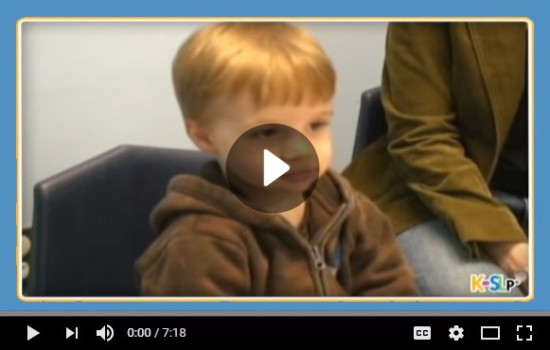
Click above for a video preview!

Reviews from Speech-Language Pathologists

This information is up to date on the challenges speech therapists face in meeting the special needs of the children they service.
I think this DVD series is very informative and would be helpful for clinics to own! This way therapists would be utilizing information/products correctly rather than guessing.
I really liked how Nancy stressed using “favorite” words/phrases to help the child increase intelligibility NOW while you work on overall intelligibility of speech.
Very impressed with the organization. It provides a variety of case studies to guide therapists in treating their child’s unique needs.
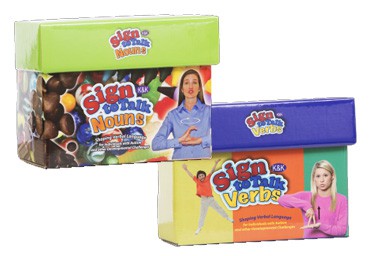
Sign to Talk – Nouns & Verbs

The K&K Sign to Talk program is designed to transition nonverbal young children with autism from sign to vocal communication. For children who are not yet vocal imitators, this program helps to promote and shape spontaneous vocal language skills by providing a bridge from signing to vocal communication. Target words are depicted using amazing real-life photos on large, glossy cards, and were selected to represent high-frequency, everyday objects (nouns) and actions (verbs) that children frequently request and that double as excellent reinforcers.


Each kit contains cards displaying high-quality photos of the target object or action on the front. The reverse side displays the ASL sign and Kaufman progressive “word shell” approximations used to shape intelligible articulation. The accompanying 40-page manual fully explains this approach. A must-have resource for any verbal behavior program!


Ages 2 to 12. Made in the USA.

VIDEO DEMONSTRATION

Learn about these products from co-creator Tami Kasper!

ORDER NOW

Visit the link below to purchase

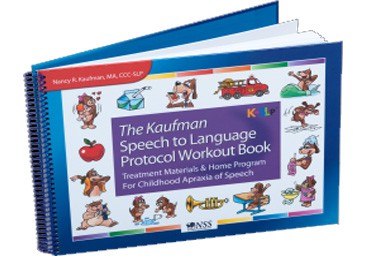
Kaufman K-SLP Workout Book

Ideal follow up material after progress is made with the Kaufman Treatment Kits! The Kaufman Kits helped to shape syllables into words. Now use Workout Book to expand single words into phrases and sentences. These materials are reproducible allowing the SLP to create home programs.


Includes 16 reproducible motor-speech coordination workouts to stabilize the pronunciation of consonant-vowel combinations, and promote rapid development of expressive language skills while controlling for oral-motor difficulty. Building on Kaufman Kit 1, the activities feature familiar Mutt Family characters and focus on consonant-vowel combinations with /m, p, b, t, d, n, h/.


Each workout explains what skill is being targeted, how to perform the exercise, and specific help that is to be offered to the child. The straightforward style of this book allows parents/caregivers to reinforce the work done by the SLP. Ages 2 to 10. Made in the USA.


  • Develops expressive language skills.
  • Includes 16 motor-speech coordination workouts.
  • Next step in therapy after Kaufman Kit 1.
  • Reproducible content to create home programs.
  • Teaches cueing techniques for specific sounds.
  • Features familiar Mutt Family characters.
  • Holds attention with colorful and engaging story themes.

VIDEO DEMONSTRATION

Learn about these products from co-creator Tami Kasper!

ORDER NOW

Visit the link below to purchase

Kaufman Treatment Kits

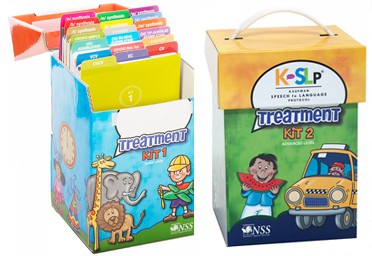
This highly effective approach builds intelligibility through a hierarchy of successive “word shell” approximations based on least physiological effort of target words. The clinician also is able to introduce more complex phoneme patterns as the child’s ability improves, thus maintaining the child’s ability to speak at his or her maximum level.


KIT 1 – BASIC LEVEL


Kit 1 teaches children to combine consonants and vowels to form words while controlling for oral-motor difficulty. The 225 visual referent cards were selected specifically to target and teach the syllable shapes children need to master to become effective vocal/verbal communicators. Treatment methods employ a systematic and progressive approach of simplifying word pronunciation patterns to shape and expand verbal expression and make communication easier for children with childhood apraxia of speech and other speech sound disorders.


KIT 2 – ADVANCED LEVEL


Kaufman Kit 2 refines intelligibility for children who have mastered sounds in Kaufman Kit 1 (p, b, m, t, d, n, h, w). Advanced level Kit 2 then works to refine articulation and build higher motor-speech coordination. Kit 2 uses familiar two and three-syllable words to target more complicated motor-speech movements and synthesis into initial and final word positions. Kit 2 targets synthesis of /f, g, k, l, s, sh/ and blends /s, r, l/ plus ber and ter.


Made in the USA.

VIDEO DEMONSTRATION

Learn about these products from creator Nancy Kaufman

ORDER NOW

Visit the link below to purchase

Kaufman Speech Praxis Test

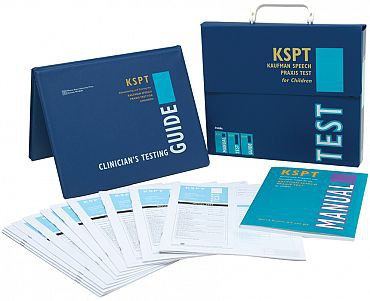
The Kaufman Speech Praxis Test (KSPT) is a norm-referenced, diagnostic test assisting in the identification and treatment of childhood apraxia of speech. Easy to administer and score, KSPT measures a child’s imitative responses to the clinician, identifies where the speech system is breaking down, and points to a systematic course of treatment.


The KSPT is useful beyond establishing an initial diagnosis, as results can be used to measure and quantify gains in speech-motor proficiency. Also, test sections can assist in developing goals for IEPs and measuring progress. Order includes complete KSPT with a packet of 25 score sheets. Additional score sheets may be ordered


Ages: 2;0 – 5;11. Admin time: 5-15 minutes.


  • Identifies where the child’s speech system is breaking down and points to a specific course of treatment.
  • Norm-referenced and standardized items that provide a raw score, standard score, and a percentile ranking.
  • Provides normative information for the “normal” pediatric speaking population and the “disordered” population.
  • Results assist in planning treatment, developing goals for IEPs, and measuring progress.
  • Breakdowns in KSPT match the levels of treatment in the
    K-SLP Treatment Kits, allowing for a seamless transition to therapy.
  • In-depth training available


OUTCOMES


The Kaufman Speech Praxis Test:

  • Measures a child’s imitative responses to the clinician.
  • Identifies where the child’s speech system is breaking down.
  • Points to a systematic course of treatment.
  • Quantifies gains in speech-motor proficiency.


TIME REQUIRED


Administer time: 5-15 minutes.

ORDER NOW

Visit the link below to purchase

Krayon Kids Handwriting Camp utilizes the Handwriting Without Tears® program developed by Jan Z. Olsen, OTR and Emily F. Knapton, OTRL. The curriculum focuses on introducing the alphabet in a developmentally appropriate sequence using hands-on and multi-sensory resources.


Camp will be led by KCC occupational therapist Chris Purgatori, MOT, OTRL, and assistants.


DESIGNED FOR CHILDREN WHO ARE:

  • Preschool and kindergarten-age (3-6)
  • Experiencing fine motor and visual motor difficulties in relation to drawing, coloring, and holding crayons and writing utensils appropriately.


MINIMUM REQUIREMENTS:

Participants should be able to participate and follow simple directions in a group setting.


CAMP CONTENT:

  • Developing skills such as pre-writing strokes and shapes with an intro to capital letters and numbers in order to prepare little fingers for writing.
  • Structured group stations with themed activities.
  • Rotating mini groups for letter instruction.
  • 1 therapist for every two children.


MATERIALS INCLUDED IN TUITION:

  • Tote bag decorated by your child
  • Get Set for School workbook
  • Folder with at-home handouts and practice sheets
  • Flip crayons
  • Wood pieces
  • Play-Doh
  • “Wet, Dry, Try” mini slate and chalk


SCREENING:

  • A brief screening is required of all children interested in the program to determine eligibility.
  • Call Chris Purgatori, MOT, OTRL, at 248-737-3430 or email to arrange a screening.

SESSION DATES

June 19 - August 17
No camp July 4 & 6

AGES & TIMES

Tuesdays & Thursdays
10:30 a.m.-12:30 p.m.

TUITION

$1,440
Payment due at registration
No refunds for missed sessions

REGISTRATION

For additional information or to register, please contact Chris Purgatori, MOT, OTRL, at 248-737-3430 or email below.

Center-Based ABA Treatment

Autism programs at the Kaufman Children’s Center

The KCC's intensive, center-based ABA program is for young children on the autism spectrum or who are experiencing other significant language and learning challenges.  Children attend for half days (3 hours) or full days (7 hours) depending on individual assessment and identified needs.

Our ABA therapists utilize the principles of applied behavior analysis (ABA), the most evidence-based intervention to address the learning needs of young children with autism spectrum disorder (ASD). The program includes both natural environment teaching (NET) and discrete trial teaching (DTT).

The goal of ABA is to jump start each child’s communication, play, and social skills by creating individualized intervention programs that can be followed by families and support/educational staff.  Daily supervision by a board-certified behavior analyst (BCBA) ensures that all teaching programs are monitored closely.

Our staff of dedicated ABA technicians receive intensive classroom instruction and hands on training before delivering ABA treatment. In addition, they are required to attain registered behavior technician (RBT) certification within the first six months of employment.

The KCC boasts a variety of beautiful, child-friendly spaces in which to learn and play.  We offer large classrooms for several children, many small, shared therapy suites for those who need a quieter place in which to learn, sensory-motor gyms, smaller, thematic playrooms, and outdoor patio spaces. Parents are able to observe many therapy sessions in observation rooms or via cameras in each therapy area.

Questions?

For more information, contact our ABA department by calling 248-737-3430 or emailing below.

Therapeutic Classrooms at the KCC

The Kaufman Children’s Center ABA program offers a range of ways for children to learn and grow based on their individual needs. Our therapeutic classroom bridges the transition from one-to-one ABA to a classroom learning environment.

The therapeutic classroom focuses on a child’s play, learning, independent work and social communication skills. These skills are targeted in a small group (six children) within a classroom-like environment. Activities are led by experienced registered behavior technicians (RBTs) under the supervision of our team of board-certified behavior analysts (BCBAs). Our therapeutic classroom program benefits from regular input from the KCC’s speech-language pathologists and occupational therapists through lesson plans that include language enrichment, fine motor and sensory activities. Together, we make learning meaningful and fun.

Our therapeutic classroom includes Language for Learning and Handwriting Without Tears curriculum.  We incorporate social skills content from a variety of sources to work on identifying emotions, problem solving and coping skills, and how to interact with others in a group.

Craniosacral Therapy

Releasing the negative effects of stress on the nervous system

Crainosacral therapy (CST) is a gentle, hands-on method of evaluating and enhancing the functioning of a physiological body system called the craniosacral system – membranes and cerebrospinal fluid that surround and protect the brain and spinal cord, extending from the bones of the skull, face and mouth (which make up the cranium) down to the tailbone area (or sacrum). The role of the craniosacral system is to maintain the environment in which the central nervous system functions. An imbalance or dysfunction in this system can cause sensory, motor, and/or neurological disabilities. Crainosacral therapy works by helping the body’s natural healing mechanisms release the negative effects of stress on the central nervous system.

Like the pulse of the cardiovascular system, the craniosacral system has a rhythm that can be felt throughout the body. Performed on a fully-clothed body, and using a touch generally no heavier than the weight of a nickel, skilled practitioners can monitor this rhythm at key body points to locate the source of an obstruction or stress. Once a source has been determined, the therapist uses delicate manual techniques to assist the natural movement of the fluid and related soft tissue to help the body self-correct, releasing problem areas and relieving undue pressure on the brain and spinal cord. When properly applied, crainosacral therapy is essentially risk-free.

Children who may benefit from CST include those with brain dysfunctions, central nervous system problems, self-regulatory and modulation difficulties, traumatic birth processes, and developmental delays, as well as various sensory disorders, including eye-motor coordination problems, autism, dyslexia, loss of taste or smell, tinnitus, vertigo (dizziness) and neuralgias (nerve pain) such as sciatica (hip & leg pain) & tic douloureux (sudden, sharp pain in the face).

CST sessions for children can last from 15-60 minutes, depending on the child’s tolerance and need. The optimal result of crainosacral therapy is a central nervous system free of restrictions and a body that is able to return to its greatest levels of performance.

Questions?

We're here to help!
Reach out with questions

Handwriting Help

Making legible & fluent handwriting an automatic skill for children of all abilities

The goal of Handwriting Without Tears® (HWT) is to make legible and fluent handwriting an automatic and natural skill for children of all ability levels. This program uses fun, entertaining, and educationally-sound instructional methods to teach handwriting to all students: preschool through cursive. HWT is unique in that it is developmentally-based, works for children of all abilities, uses multi-sensory teaching aids and methods, and is easy to teach and fun to learn.

If a child is having trouble with handwriting, an evaluation can be conducted (regardless of what handwriting methods may be being used at school) to assess upper case, lower case, number skills, spacing, and size. This will allow us to determine a child’s strengths and difficulties, and we can then develop a customized remediation plan that will specifically address each area of challenge.

This program features:

  • Engaging techniques and activities help improve a child’s early self-confidence, pencil grip, and body awareness skills.
  • Multisensory techniques and consistent habits for letter formation to help all children learn.
  • Unique strategies to teach good letter formation, spacing, neatness, and cursive connections.

Children enjoy HWT because it makes handwriting easy and fun to learn. This program can be completed in 6-8 weeks (depending on the child & home programming) and includes a weekly 45-60 minute session at our center, as well as weekly home programs.

Questions?

We're here to help!
Reach out with questions

Therapeutic Listening

Auditory support for sensory processing, listening, attention, and communication

Therapeutic Listening® (TL) is an expansion of sensory integration. It is an auditory intervention program that uses the organized sound patterns inherent in music (using specially-modulated and filtered sounds) to impact all levels of the nervous system, by providing direct input to both the vestibular and auditory portions of the vestibular-cochlear continuum. TL can impact sensory modulation, attention, speech/language difficulties, postural organization, and behavior. This program utilizes numerous CDs that vary in musical style, types of filtering, and complexity. The music on Therapeutic Listening CDs is electronically altered to elicit the orienting response which prepares the body for sustained attention and active listening.

Therapeutic Listening® is an evidence-backed protocol that combines a sound-based intervention with sensory integrative activities to create a comprehensive program that is effective for diverse populations with sensory challenges. The use of modulated and filtered music in conjunction with other sensory integrative techniques seems to increase the effectiveness of both treatment modalities.

When incorporated into a sensory integrative treatment approach, children of all ages can benefit from Therapeutic Listening® in a variety of areas, including: attention; organization of behavior; self regulation; development, refinement, and mastery of postural and motor skills; bilateral motor patterns; fine motor skills; articulation; praxis skills; arousal; modulation; motor execution; and auditory, visual, and vestibular integration.

Communication changes consistent with the use of TL include: spontaneous vocalizations, longer sentences or word utterances, increased timing of verbal and social expressions, improved turn-taking skills, heightened emotional awareness, and changes in vocal intonation. Discrimination of dimensionality, directionality, or spatial concepts (such as high/low/big/small) is frequently seen in participants.

Integrated listening programs can be carried out at home, school or in a clinic with ongoing support from a therapist who is trained in their use. A typical program may be in place for two to six months for initial gains. However, many individuals continue past this time frame or find several of the compact discs useful as part of an ongoing sensory diet.

Questions?

We're here to help!
Reach out with questions